
Clear or Premium Clear – which film for which table?
In short
Clear is the thinnest and cheapest film – it suits furniture and surfaces with normal use. Premium Clear is thicker and self-healing for fine scratches; we recommend it for dining tables, desks and worktops that are used hard every day. Both are crystal clear and glossy, and both adhere to the same smooth, closed surfaces.
Two crystal-clear films, one price difference: how Clear and Premium Clear differ, when the thicker one pays off and when the thinner one is enough.
Updated:
What both have in common
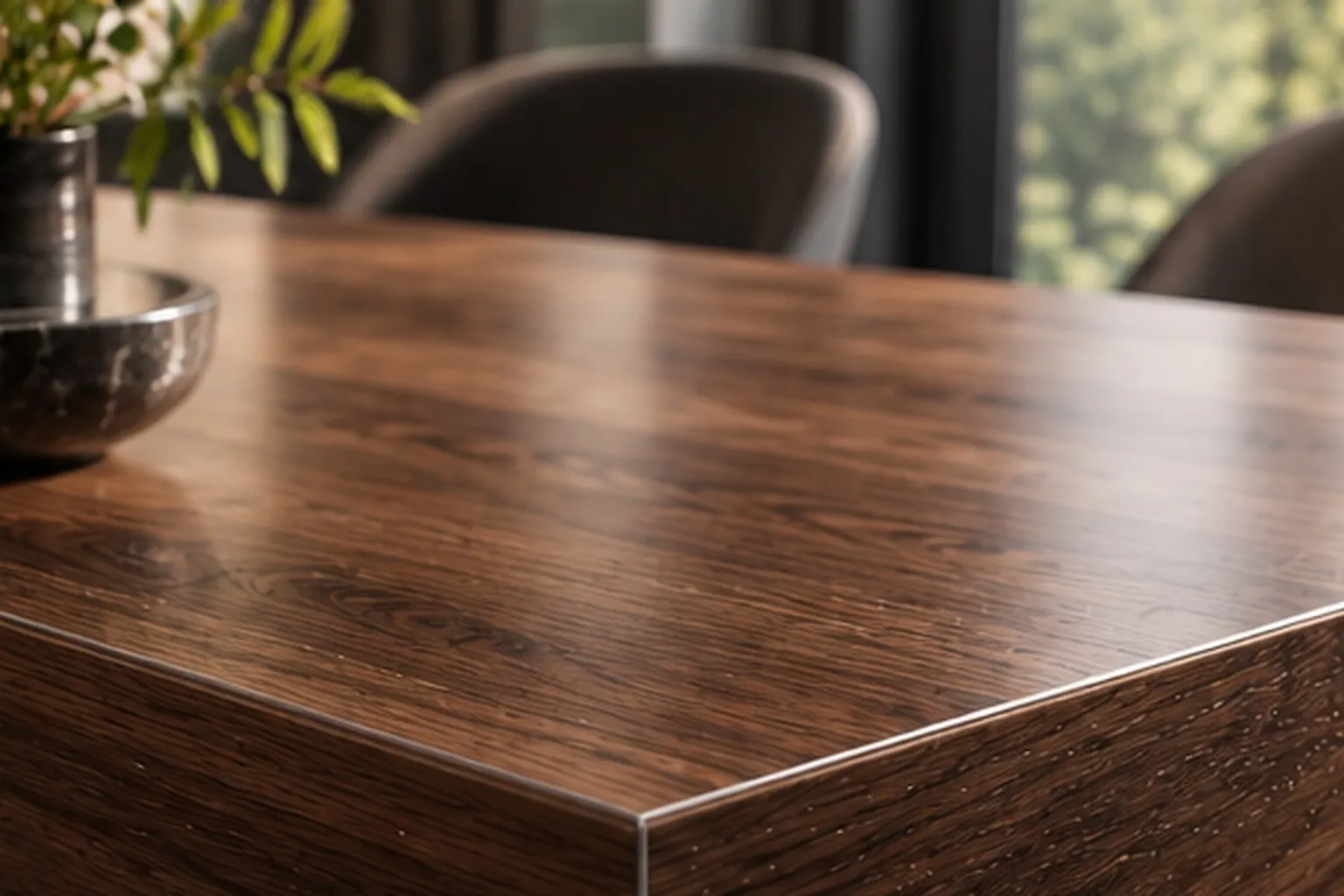
Clear and Premium Clear look the same on the surface: crystal clear and glossy. Grain, colour and texture of the panel stay visible, and on smooth, closed surfaces the film is practically unnoticeable. Both use an acrylic adhesive, both are applied wet and squeegeed, and both can be peeled off again later.
The surfaces they hold on are the same too: painted, sealed, foil-wrapped and coated wood, glass, ceramics, metal and smooth plastic. Oiled and waxed panels are not suitable for either. So the choice between Clear and Premium Clear does not depend on your substrate, but on how heavily the surface is used.
Clear: the thinnest film in the range
Clear is our basic film. It is the thinnest film in the range and therefore follows tight radii and edges well. It has the lower price per square metre – which you notice above all on large surfaces that are to be covered completely.
It has no self-healing surface. Fine scratches that get into the film stay visible. For surfaces with normal everyday use this is usually not a problem: a sideboard, a chest of drawers, a coffee table, a shelf, a room door. For worktops and dining tables that are used hard every day, we ourselves call Premium Clear the better choice.
Which film for which surface?
As a rule of thumb: the more often and the harder the surface is used, the more Premium Clear pays off. A dining table with children, a desk with laptop and mug, a kitchen worktop – this is where the fine scratches that even out by themselves occur most often.
Clear is enough for surfaces that are looked at rather than used: sideboard, chest of drawers, shelf, bedside table, room door, windowsill. If you want to cover a very large surface completely and price is the deciding factor, Clear can also be the right choice.
A mix is perfectly fine: dining table with Premium Clear, the sideboard next to it with Clear. In the configurator you choose the film per cut piece, and both end up in one basket.
And if you are unsure?
The sample set contains a piece of each film. This way you check transparency, feel and finish on your own surface before you order. With unclear substrates, also check that the film adheres across the whole area.
The assistant asks about surface, desired look and use and names the matching film. And if your case falls in between, send us a photo of the surface – we will tell you what we would take in your place.
Frequently asked questions
Can you see the difference between Clear and Premium Clear?
Not on the surface: both are crystal clear and glossy. The difference lies in the thickness of the carrier layer and in the self-healing surface of Premium Clear.
Do all scratches disappear in Premium Clear?
No, only fine scratches disappear again in the surface. Deep scratches and cuts, for example from a knife, remain visible in Premium Clear too.
Can I mix Clear and Premium Clear?
Yes. In the configurator you choose the film for each cut piece separately. Dining table and sideboard can get different films and still end up in one order.
Does this difference also apply to Matte and High Gloss?
In part. Like Premium Clear, High Gloss is self-healing for fine scratches; Matte, like Clear, is not. Matte takes gloss out of the surface; High Gloss is the thickest film, for piano lacquer and vehicle paint.