
When protective film does not hold: texture, oil and rough surfaces
In short
Protective film needs a smooth, closed surface. Oiled and waxed wood, raw wood as well as rough plaster, coarse natural stone, fabric and cork are not suitable. Lightly textured and unknown surfaces we check on a sample or from a photo.
Suitability follows a simple logic: the adhesive needs a closed surface. Which surfaces fail, which need a check and what you can do then.
Updated:
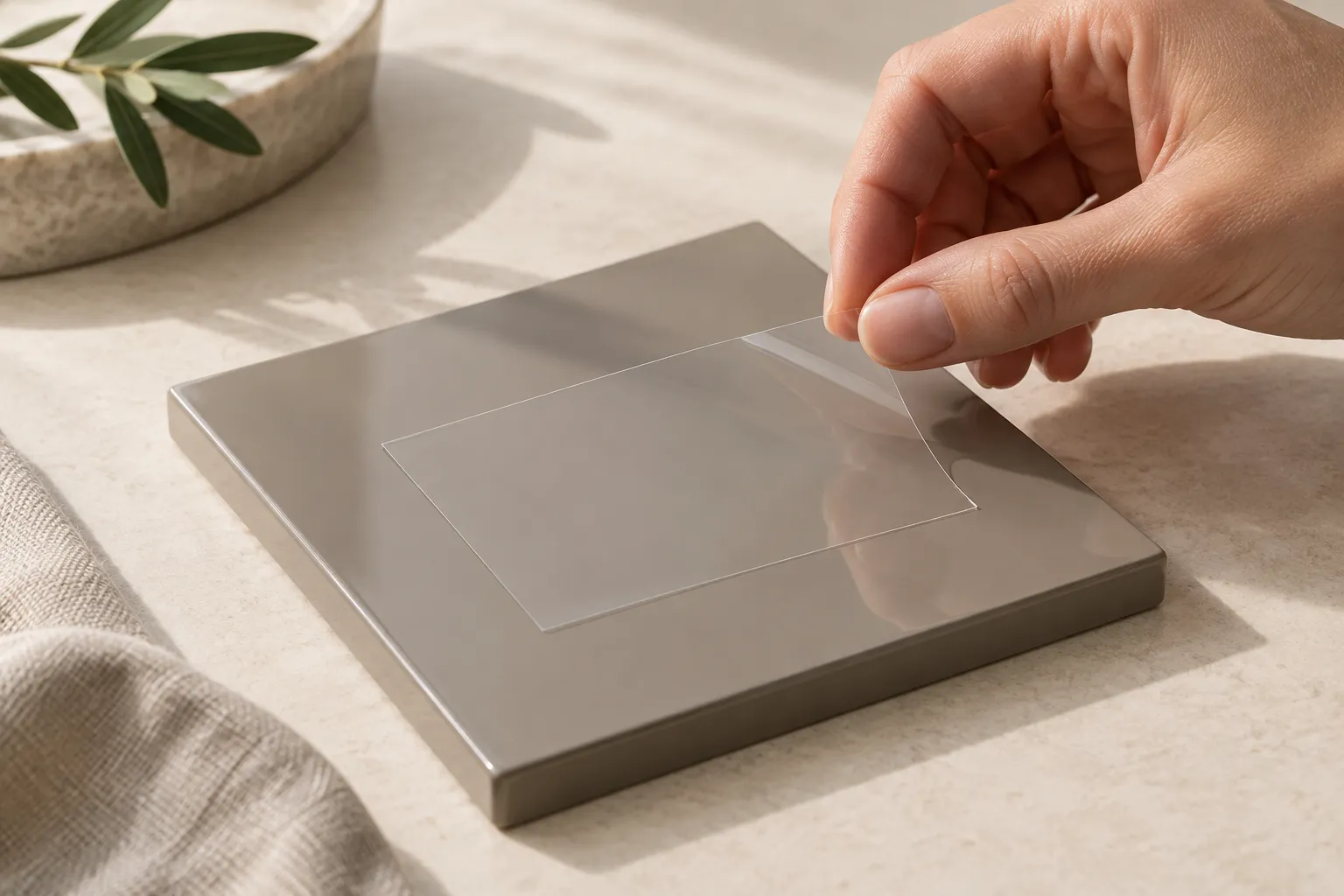
The logic: the adhesive needs a closed surface
Our films adhere with an acrylate adhesive. It holds across the whole area on smooth, closed surfaces: paint, coatings, glass, ceramics, metal and smooth plastic. That is the rule from which everything else follows.
So you do not need to memorise a list of materials. For every surface ask yourself: is it smooth, and is it closed, without oil, wax or open pores? If yes, the film holds. If not, read on.
Oiled and waxed: the film comes off
Oil and wax prevent adhesion. On an oiled solid wood top or a waxed front the film comes off, even if it seems to hold at first. We generally advise against it here.
The problem is the treatment, not the wood: a painted or sealed top of the same wood is suitable. If you do not know how your top is treated, send us a photo of the whole surface and a detail of surface and edge.
For oiled tops a loose pad that only lies on the surface and does not stick fits better.
Raw, open-pored and rough: no closed surface
Raw, untreated wood and coarsely brushed oak have open pores. The adhesive finds no closed surface and does not hold across the whole area.
With rough plaster, coarse natural stone, fabric and cork it also happens that the film cannot follow the texture. Air channels remain and the edges lift. We advise against it here too, even though the film is thin.
Lightly textured and unknown: check instead of guessing
A fine wood embossing, a soft-touch surface or a fine linen pattern lie in between. Whether the adhesive holds across the area depends on the texture. We give no blanket approval for this but check it on a sample.
The same applies to unknown material and to polished natural stone. A photo and a short description are enough for a first assessment. With the sample set you lay pieces of all films on your surface and check the adhesion yourself.
Test at a hidden spot before every order. That way you find out how surface and film behave before you cover the whole surface.
When the film is already on and does not hold
If a film comes off at edges or corners, it is usually due to one of the causes above: oil, wax, texture or dust and grease under the film. In that case send us a photo.
If you peel the film off, it comes off slowly and at a flat angle. A peeled-off film cannot be used again.
Three questions for a quick check
First: does the surface feel smooth, without pores and without embossing? Second: is it painted, coated or sealed, not oiled, waxed or raw? Third: is the paint, if it is paint, cured?
Three times yes means: suitable. A no to the first or second question means check or advise against, a no to the third means wait. For the normal case you need no more than these three questions.
What we do not claim for light texture
For lightly textured surfaces we deliberately do not say that a particular film holds there. Whether even Premium Clear adheres across the area on a fine embossing is not proven; that is why it says “check” there and not a purchase recommendation.
That is not evasion but the honest state of things: we would rather tell you that we have to check than have you order a film that comes off. For the assessment you send a photo of the whole surface and a detail of surface and edge.
What to do instead for unsuitable surfaces
If the surface is unsuitable, that is no disaster. For oiled or raw tops a loose pad that only lies on the surface fits. For surfaces with strong texture there is no solution with our film, and we then advise against it instead of accepting an order that comes off.
Sometimes only part of a piece of furniture is the problem. A door with a smooth front and a rough frame can be covered on the front if you measure only that surface.
Frequently asked questions
Does the film hold on painted wood?
Yes, on closed, cured paint. Freshly painted surfaces need at least four weeks of curing first.
Can I seal an oiled top beforehand?
We give no recommendation on that. Send us a photo and we will tell you what is possible for your top.
How do I check adhesion beforehand?
With the sample set you lay a piece of every film on your surface. For unclear surfaces we also check adhesion on a sample of your material.