
Covering large surfaces: planning strips and seam
In short
If the shorter side is wider than the roll, you divide the surface into strips of equal width with 2 cm overlap and order them together. For rectangle and square the configurator calculates the strips. With transparent film the seam is hardly noticeable if it lies at an edge or joint.
Cooking island, kitchen run or conference table: when a surface does not fit on the roll, how the configurator divides it and what matters when laying.
Updated:
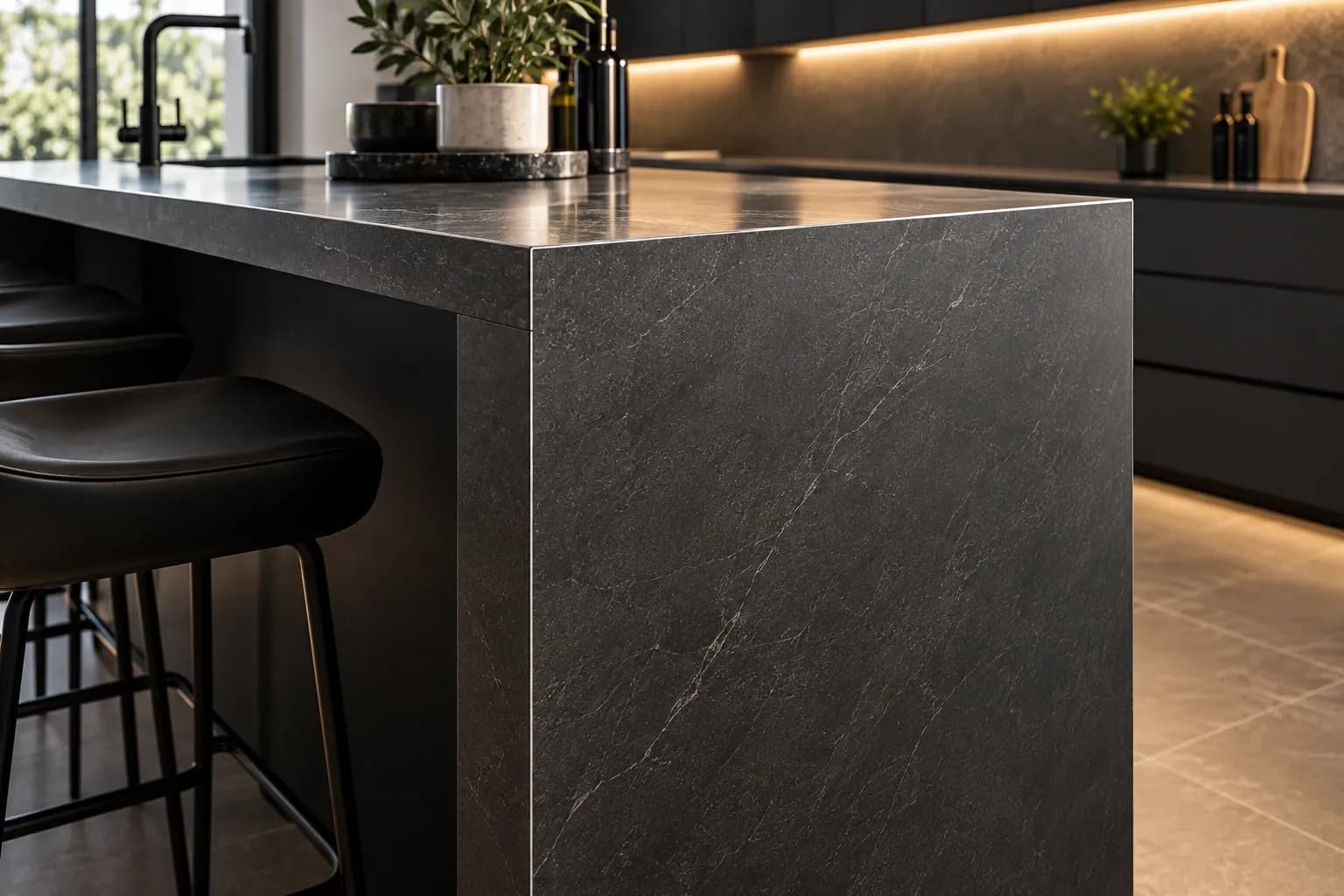
When a surface does not fit on the roll
The film is cut from the roll. The shorter edge of your surface therefore may not be wider than the roll, while the longer one is free up to a maximum length. A long, narrow worktop usually fits, a large cooking island or a conference table often does not.
Which width and length currently apply is shown in the measuring guide, and the configurator reports it as soon as a dimension is outside the limit. If the surface fits the roll when turned, it is a single strip and you do not need to divide anything.
How the configurator divides into strips
For rectangle and square the configurator calculates the strips for you: strips of equal width along the long side, each at most as wide as the roll. Neighbouring strips overlap by 2 cm so that the seam is covered during application. You order the strips together.
For every other shape it does not calculate, because there a strip is no longer a partial area of the same shape. How such a surface should be divided you decide together with us, for example via freeform or an enquiry with photo and dimensions.
Where to put the seam
With transparent film the seam is hardly noticeable. Still, put it where it does not bother anyone anyway: at an edge, a joint or a transition.
We promise no more than “hardly noticeable”. How the seam looks on your surface depends on the surface and the light; the sample set shows you the film on your surface beforehand.
Laying as a pair and section by section
A dining table, a worktop or a kitchen front in one piece is doable, but not alone. One person holds up the wetted film, the other lays it down from one edge and squeegees.
Squeegeeing is done section by section: from the centre of the strip outwards, then the next strip follows. The steps of wet application apply to each strip individually, and most bubbles form before laying, from dust, grease or too little application solution.
The guide also shows the laying of large surfaces as a video as soon as there is one.
Planning before you order
Measure the whole surface in several places and consider where the seam should lie. The trial template at 1:1 also helps with strips: you lay it on the surface and see whether the division fits.
You order the strips together, and each strip arrives individually. In the cart you see them with dimensions, film and cutting option and can check before checkout whether everything matches your plan.
Example: 200 by 250 centimetres
A surface of 200 by 250 centimetres, for example a large cooking island, is wider than the roll on both sides. Without division it could not be ordered. The configurator divides it into strips of equal width along the long side. Each strip is slightly wider than half the surface because the overlap is added, and it arrives as its own piece at the full length.
You order the strips together and see in the cart how many there are. How many strips your surface needs depends on the roll width, which is stated in the measuring guide.
If the surface is not a rectangle
A corner worktop or an island with rounded corners is not a simple rectangle. For such surfaces the configurator calculates no strips. Agree the division with us: send a photo, the dimensions of the enclosing rectangle and a short description.
That way we decide together where the seam goes, instead of an estimate leading to a wasted cut.
Frequently asked questions
Do I have to calculate the strips myself?
For rectangle and square no, the configurator calculates them. For other shapes you agree the division with us.
How wide is the overlap?
2 cm. It covers the seam during application.
Can you see the seam?
Hardly with transparent film, especially at an edge or joint. We promise no more.
Can I lay a large surface on my own?
We advise working as a pair: one person holds the film, the other lays it down and squeegees.