
Calculating film needed: area of rectangle, circle and oval
In short
You measure the area the film is to cover and calculate it in square metres: for a rectangle width times length. The configurator calculates with the area of your shape, not with the enclosing rectangle. If the shorter edge does not fit the roll, you divide the surface into strips.
Area in square metres, examples for rectangle, circle, oval, trapezoid and L-shape, and what the roll width means for the quantity.
Updated:
What you calculate and what the configurator calculates
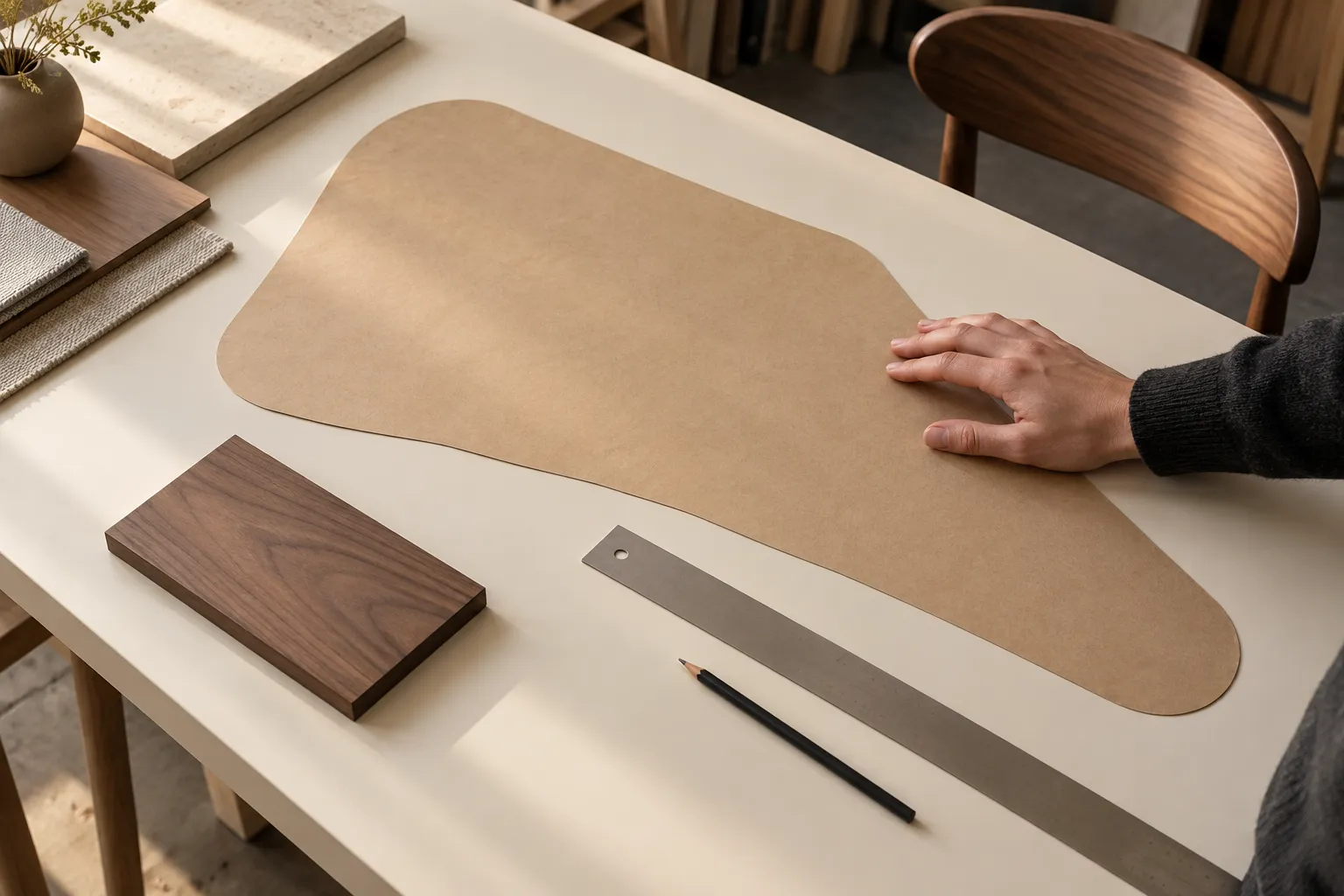
The price of the film depends on the area of your shape times the price per square metre of the chosen film. The calculation uses the area of the shape, not the enclosing rectangle: a round table therefore costs less than a square one whose edge length equals the diameter.
You do not have to calculate the area yourself; the configurator shows price and dimensions live. But recalculating helps with planning: you see how shape, film and quantity have an effect before you enter anything. We name no prices here, they come live from the shop.
Rectangle and square
Convert the dimensions to metres and multiply them. A table of 90 by 180 centimetres is 0.9 by 1.8 metres and therefore 1.62 square metres. A square with a side length of 60 centimetres is 0.36 square metres.
With several identical pieces you multiply by the quantity. Twelve fronts of 60 by 72 centimetres are twelve times 0.432 square metres, together 5.184 square metres. Each piece is cut individually.
Circle and oval
For a circle you need the diameter, not the radius. The area is pi times radius times radius. A circle with a diameter of 100 centimetres has a radius of 0.5 metres and therefore around 0.79 square metres, a square with an edge length of 100 centimetres one whole.
For an oval you enter the greatest width and the greatest length, each measured through the centre. The area is pi divided by four, times width, times length. An oval of 100 by 160 centimetres comes to around 1.26 square metres.
Trapezoid, L-shape and U-shape
For a trapezoid the area is the mean of the two parallel sides times the height. 120 at the bottom, 80 at the top and 60 centimetres high give 1.0 times 0.6, so 0.6 square metres.
For the L-shape you split the area into two rectangles. With 120 centimetres overall width and 100 centimetres overall height, a vertical leg of 40 and a horizontal one of 40 centimetres, that is 1.2 times 0.4 plus 0.4 times 0.6, together 0.72 square metres. You calculate the U-shape from three rectangles in the same way.
Roll width and minimum area
The area does not yet tell you whether your cut fits the roll. The shorter edge may not be wider than the roll; you lay wider surfaces from strips that overlap by 2 cm. The extra film that the overlap needs is included by the configurator in the strips.
Very small cuts are charged at least at a small minimum area, and the shortest edge has a minimum size. We do not charge you for offcuts from the roll.
Converting centimetres to square metres
Anyone who measures in centimetres calculates fastest in square centimetres and divides by 10,000 at the end. A table of 90 by 180 centimetres has 16,200 square centimetres, divided by 10,000 that is 1.62 square metres. The result is the same as with metres, just without decimals when multiplying.
You divide millimetres by ten first. The configurator expects width, length and diameter in centimetres, accurate to a millimetre, and the corner radius in millimetres.
Quantity, cutting option and what else counts
Besides the area, quantity and cutting option determine the cost. The surcharge for “Exact to size” applies per piece and does not depend on size: for large surfaces it hardly matters, for many small parts it adds up. For freeform a surcharge per piece is added.
In addition there is value-added tax, which is included in the prices, and shipping costs. The configurator shows the exact amounts in the price line.
Plausibility check with the configurator
Enter your dimensions in the configurator and compare: does the area you calculated roughly match the price you see? If not, you have either mixed up a dimension or a unit. The first thing to check then is whether you swapped centimetres and millimetres.
The trial template is good for the cross-check: it shows whether the shape lies on your surface before you order.
Frequently asked questions
Do I have to calculate the area myself?
No, the configurator calculates it and shows the price live. Recalculating helps with planning.
Do I pay for the enclosing rectangle?
No, the calculation uses the area of your shape.
Do you charge for offcuts from the roll?
No, we do not charge you for offcuts from the roll.
What if my surface does not fit on the roll?
Then you divide it into strips. For rectangle and square the configurator calculates them.